Monday, 28 November 2011

Task 1 - Panopticism

Panopticism is a theory of social control outlined by Michel Foucault in his book, Discipline and Punish, and is based around an idea of surveillance developed during a period when institutions such as asylums, penitentiaries and reformatories were in their earliest forms. It relies entirely on the reformation of individuals captive through controlling them mentally.
The Panopticon (Jeremy Bentham, 1791) became ‘the architectural figure of this compostition’. Foucault states that ‘it reverses the principle of the dungeon’, preserving only its primary function of enclosure. Inmates are kept in cells individually, which surround a central tower that is not lit. Each cell is lit from the outside wall, meaning that the inmates can always be seen from the central tower, but cannot see into the tower themselves. The major effect this has is ‘to induce in the inmate a state of conscious and permanent visibility that assures the automatic functioning of power’.
There are many elements of contemporary society that could be seen as remaining elements of this panoptic form of social control, one of the major examples being CCTV cameras. It is thought that people are filmed more than 300 times a day by these cameras and we are constantly reminded of this fact through the media. They are always present where ever you are so it is evident that one could always see you. However like the central tower in the panopticon it is unclear as to whether you’re actually being watched by anyone at the other end of the camera; ’power should be visible yet unverifiable’.
This means that people act in the way that they believe they should act if they are being watched, whether they are or not. CCTV cameras also have the effect of deterrence in their positioning, and the signs that are used to warn people of their presence, as soon as someone is made aware that they could be under surveillance they will act as they believe they should, becoming, as Foucault described, a ‘docile body’. This also means, that often the cameras don’t have to work, as it is impossible to tell whether they are or not, and it is the possibility that you could be being watched that makes you behave in such a way. The sign warning you of the camera and the actual presentation of the camera therefore becomes more important than itself due to the effect of ‘self-regulation’ that this instills upon the person.

Sunday, 6 November 2011

Seminar #1 - Panopticism

FOUCAULT.
Panopticon - Jeremy Bentham - 1791
Psychological effect
Internalise the idea that you're always being watched / under surveillance
-Makes you behave in the way you THINK people believe you should

-Most lunatic asylums used the panoptic structure. Prisons still around with this design
-Can be found everywhere

Key features
-Seperated/isolated - can conspire/talk/relate to other there if they aren't isolated
Designed as a sort of laboratory to monitor behaviour.
- Invisibility/visibility - inmates must believe that they are permanently on view
the person viewing them must always be invisible
Central tower is there as a reminder to inmates that someone with power could be watching... this prevents people from doing things wrong through fear. 
"invisibility of power"
-Productivity - was designed to make people more productive
not go crazy...
Efficient reform of behaviour.

CCTV cameras - not panoptic if they are hidden but constantly recording / stealth recording.
When they are made visible .e.g. the yellow signs about the signs become more important than the cameras themselves.


Open plan offices - where the boss can always look over people working.
People are less likely to procrastinate.


Social networking & online media - measure yourself against people and act in a way that you think they will like.
- constantly visible to the world
- productive because people bring business to the company without realising.

Docile Bodies
-productive
-obedient
-self-regulating     self-monitor  <>  self-correct


They are created by modern disciplinary society
modern > shift from physical control > mental control 
Often spectacular & humiliating physical control...

Although panopticism is a form of mental control, it also controls the body physically.
Foucault said :
"Power is a relationship between people" A <> B
Which works both ways...

Teacher has qualification - knowledge - status allowing him to control&discipline his pupils.
> this relies on his pupils allowing this, and not resisting to his discipline.

Media - TV programs - Films.
Display perfect situations - ideals
-perfect bodies
-perfect lives etc
people blindly follow and in turn are productive in a way thats beneficial to the company.

Tuesday, 1 November 2011

Lecture 2 - 'Technology will liberate us'

Digital currents - Margot lovejoy
The art in the age of mechanical reproduction - Walter Benjamin (1936)
Art in the age of mass media - John Walter
Simulacra & simulation - Jean Baudrillard (1981)

Implications of technology on different design areas
Technological conditions can affect the collective consciousness
- materialism // it's effect on society.

Triggers important changes in cultural development

By copying something - mimicking - it becomes a work of art in itself, because it has been altered by the copying process . It's a work on its own // image representation.

Relationship between art, design & media can be summed up by the doodles on the previous page, copying an image three times from an original sketch, each one differs from the last.

MACHINE AGE - modernism
Walter Benjamin
- commited suicide after the war
- the age of technology and art
- A duality expressing the zeitgeist
- Dialectical due to the copy, reproductive nature and the role of the original
-The 'aura' and uniqueness of art

Never would have had to think about this without the emergence of technology and developments in reproduction processes and quality.

Photography is the beginning of the technological art, art/design relationship.
 - Isn't only what you see // photography creates multiple viewing points

Dziga Vertov - Man with a movie camera (1929)


The cameras eye has a variable gaze.
represents technological progress and faith in it.
Paul Valery

Moholy Nagy
-Photograms
Early experiments with photographic technology

Benjamin and two parallels
Freud & Marx 

Freud - obsessed with the subconscious and the material aspects of technology
Marx - Looked at the economics of art - economics & value of a piece.

the value of art can change because of consumer nature due to endorsement etc
Consumerism & reproduction can add value to art
Celebrity-ism adds further.

"photography overturned the judgement seat of art"
Margot Lovejoy 

How technology can express deepest subconscious
-virtual realities/surrealism


Kineticism 
-Capturing movement - Etienne Joules Maret
images of the moving body , 'chronophotography' 1888 was the forefather to cinematography.


Explores how time - duration - space can be depicted in art and photography through the development of technology.

De-materialisation of art
-moving image - recorded image moves away from form and object and become JUST IMAGE
This makes it easier to copy / reproduce.

Richard Hamilton - 1922
- collage
technology to create image 
images are ordered, coded and styled
beginning of art and design merging.
-Printed image is part of everything.

Karl Marx & techology
- Technological determinism
- believes theres a logical relationship between economical production & social factors.
- alienation - works as a tool

-technology drives history
-technology and division of labour
-materialist view of history
-technology, capitalism & production
-social alienation of people from aspects of human nature as a result of capitalism.

alienated from distinctive creativity and community

ELECTRONIC AGE - post modernism 
post modern & post machine
- Many electronic works were still made with a modern aesthetic
- Emergence of information & conceptual works.
- Computer is a natural metaphor.
- Spirit of openness to industrial techniques - much more cased in consumerism & materialism
- Collaborations in art & science.
- Boundaries are broken between distinct areas of art as a result of technology.

Chalayan...
Conceptualisation of fashion
divergence of factors

>Douglas Rosenberg - Falling/falling


-Electronic/video work showing collaborations between many areas of art & design

 video itself becomes an object, something that can be displayed in an exhibition.
>Douglas Rosenberg - Venus Flow


Shift in attitude for discovery of post modern age
Simulation - reflection of a profound reality.
A copy of something real...

Simulacrum states a simulation then becomes a work in its own right.
Real > illusion 
Original > copy
Distorts profound reality.
yet can become reality in its own right, and doesn't need to appear realistic. fantastic...
ONE CAN REPLACE ANOTHER 

Word of mouth masks the absence of the thing itself > so it is taken as fact / reality.


Nam June Paik
Plays with the idea of real and virtual
> Two go hand in hand
> whos watching who?

John Walker (2001)
criticises the use -art and mass media.
                            -art in advertising
                            -artists as celebrity
(Andy Warhol)

DIGITAL AGE
- Digital potential leads to multimedia productions
- Technological reproduction of all images so they are addressed by the computer...
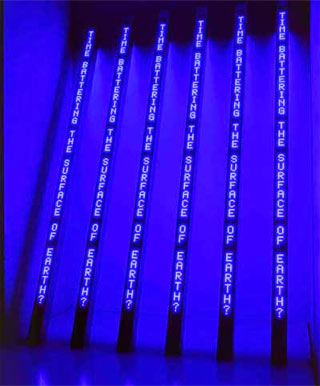
Jenny Holzer - transforms through projection.
Blue tilt (2004)


Baltic (2004)


Extension of gallery space beyond its actual size... to the outside...

Frank Gillette
the human race machine
Developed technology for morphing faces . Collaborated with the FBI

Multimedia work
-Interactivity
-Performance
-Transdisciplinary
-Time, space and motion explored in art & design, also as art
-Collaborations

Hyper-real - reality by proxy.
- art comments on ideology of everyday life
- technology blurs the line between production of fine art & commercial design production
- art can be expressive or progressive.

Monday, 31 October 2011

Lecture 1 -Institutions and institutional power - panopticism

1791 - The Panopticon - Foucault saw this as a metaphor for discipline & social control.

MICHEL FOUCAULT
(1926 - 1984)
- Madness & civilization 
- Discipline & punish : the birth of the prison. 


Both writings survey the rise of institutions & their power.

Madness & civilization
- The great confinement (late 1600s)
 > beforehand, mad people, those other than the norm were almost accepted i.e the village idiot...
- Those who were deemed not useful to society were put into 'houses of correction'
 > this wasn't just the insane, included criminals, single mothers, unemployed , the idle.
 > they were forced to work, through threats and violence
- People began to see these 'houses of correction as a gross error'
- The combination of people, the mad, criminals etc... began to corrupt everyone else in the institutions.

Specialized institutions then began to crop up.
Asylums for the insane
> people were controlled by being treated like minors/children
> made to work by giving them rewards for doing well
* gold star

This marked a shift from physical control to mental control 
- which still goes on.

& the emergence of specialists - doctors - psychiatrists
these were there to legitimaise the institutions

Internalised responsibility
>shift from someone else controlling them, to their own conscience.

Deviants used to be punished in the most humiliating / violent / public manor possible
GUY FAWKES
- This was meant not to correct their behavior but to control them, by showing what will happen if they do wrong.

Disciplinary society & disciplinary power
Foucault describes discipline as a technique of modern social control

JEREMY BENTHAM'S PANOPTICON
proposed 1791 but never actually made.
- Bentham thought it could have multiple functions > school > asylum > but mostly... a prison.

A circular construction with rooms around the outside and a central tower with a view of all the rooms.
Each room is back lit so that the subject is clearly visible.
The central tower is in darkness so that the inmates cannot see into the central tower.

Presidio, Cuba applies the same principle - a real prison!

Inmates are permanently on display
and permanently isolated

They know they are being watched but are not able to verify it due to the central tower (representing institutional power) not being lit
> the effect this has is that inmates will always behave in the way they think they should if they're being watched.
> because of the belief that they are always under scrutiny.
> people in turn begin to control their own behaviour.

Eventually - there didn't need to be guards in the tower because the physiological effect brought on just from believing that they were being watched was enough.
Perfect mechanism for control.
- People build up internal discipline
foucault called it a "machine for the automatic functioning of power"

The panopticon also allowed for measured performance of inmates - another mechanism of social control
They then assumed responsibility for their own actions > making them more productive.
it's to do with the arrangement of the space > allowing for scrutiny by the institution and pushes production from the worker/inmates/students...

-reforms prisoners
-helps treat patients

PANOPTICISM
this is the emergence (for foucault) of a new model for control.
panopticism is about training. training the minds of the people under scrutiny.


RELIES ON THE KNOWLEDGE YOU'RE ALWAYS BEING WATCHED, AND ARE AWARE OF IT. IN TURN MAKES YOU WORK HARDER BECAUSE YOU THINK THAT YOU'LL BE CAUGHT OUT.

Examples of panopticism in practice.
-Open plan office
The Office - Ricky Gervais puts on a facade that he's the perfect boss for the cameras because he knows he's being watched and others will see it.
-Libraries
No one tells you to be quiet or to control yourself, you just do...
-Art Galleries 
-Bars 
Modern bars move away from stalls and seperate compartments in favour of more open plan bars with good visibility throughout.

YOU CORRECT YOURSELF!
It means that spaces are easier to control...


CCTV, Google maps.
these build into you the fear of always being caught out because there could always be someone watching you.

Pentonville prison
-lecture theatre aims to make people more productive.

However it doesn't apply only to the design of a space.
-The register
-Staff files - doesnt know what's in it.
Paranoia 
the idea that people are keeping records on you
-Visible reminders that they are being monitored, so they won't step out of line.

Prevention methods. (fake cameras etc) 
college cards > red & blue differentiates between students & staff.
Monitored hours - clocking in & out of college

Relationship between power, knowledge & body 
-direct relationship between mental control & physical responses.
People become 'Docile' obedient bodies. - produced by modern disciplinary society.
society
-Self monitoring
-self correcting
-obedient.
Disciplinary techniques.
-government campaigns about going to the gym
-means people will be more productive as they're healthier.
- people should work longer and harder now because they are healthier.
Panopticism relates to the body
Body is always on display > make yourself anxious

Television is like a metaphor for the panopticon 
with everyone focused around a central point yet they are all watching individually.


Foucault & power
Power isn't a 'thing' which people have, that they can wield.
It is a relationship
The exercise of power relies on there being the capacity for resistance.

1984 - film

Facebook is also panoptic.
Everything you post will be recorded so people aren't themselves.
It's a performance


Vito Acconci 'Following piece' (1969)
follows someone - stalking
live in the illusion we are in control of our actions/situation.

Chris Burden - Samson (1985)


Foucault - Panopticism as a form of discipline
               - techniques of the body

TRAINS US TO CONTROL OURSELVES... DOCILE BODIES.

Monday, 28 March 2011

Task 5 - summary of 'Thinking with Type' & Deconstruction

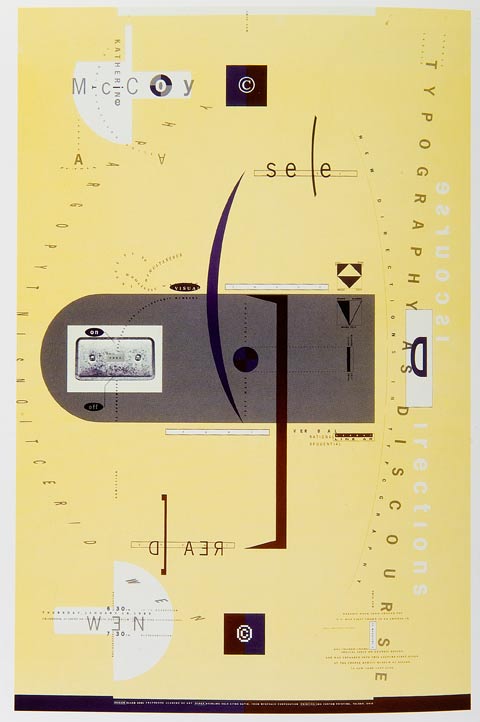
 Allen Hori - 'Typography as discourse poster' - 1989
webdesignstuff.co.uk

From reading Ellen Lupton’s writings, (‘Thinking with type’, 2008, pp.87-100), it is clear that deconstruction as a theory is one of great complexity, containing many underlying theories on how text can be constructed to portray meaning and change a texts ‘tone of voice’. The theory of deconstruction was first devised by French philosopher Jacques Derrida in the 1960s, and in short, is an approach to text which aims to analyse the systems of representation used when writing and the surrounding systems that frame their communication.

Deconstruction looks at examining the relationship between speech as the primary method of communication and writing as the secondary. This is based on writing being once removed, so it is not a direct response to a person, it also requires learning and equipment to achieve. Whereas speech is a direct form of communication that gains meaning from its delivery and the way in which it is formed during spontaneous conversation.

Deconstructivist designers look at the written word as equal to, if not more important than speech in conveying meaning. This is down to the role of typography and the designer, in the creation and implementation of meaning within the text itself.

A conventional typographic layout would emphasize the completeness of a work and its authority as a finished product. Alternative design reflects how the meaning originally intended by the author can often be lost through the design of the page in order to help the flow of information. Deconsturctivist designers such as Katherine McCoy use a text to challenge the reader in producing their own meaning and finding their way through the text.

Ellen Lupton’s text also outlines how designers generally treat a body of text the same throughout a document as this gives it the feeling of being coherent and evenly distributed across a document. A designer then uses their knowledge of how texts are taken in to help the reader navigate through long bodies of writing whether this be through the use of paragraphs, indents, or when working digitally, hyperlinked text. It is seen as the job of a designer to utilise typography in order to help the reader navigate the flow of content, however Lupton (‘Thinking with type’, 2008, pp.87) writes, “one of design’s most humane functions is, in actuality, to help readers avoid reading”

French critic Roland Barthes like Derrida looked in great detail at typography’s role in creating meaning and looked at the idea that while talking is a form of communication that flows in a single direction, writing occupies an element of space as well as time.  Therefore written text can be used spatially to portray various meanings and give a text a whole dimension in the way it is read, which can’t be used in the same way through speech. This is backed up by this quote from Barthes(“from Work to Text”, 1971). “A text…is a multi-dimensional space in which a variety of writings, blend and clash.”

The theories of deconstruction are then reflected in deconstructivist design as a critique of design conventions, by using these agreed typographic conventions differently. Which I think is summarised in the image that I have chosen to analyse, Allen Hori's, 'Typography as discourse' poster. I really like this poster however it is evident that everything to do with the flow of content and user friendliness from the  writings above have been dropped in order to help the reader create their own meaning from the text on the poster. There is no hierarchy of information as text is placed in what looks like a totally random configuration in various point sizes, fonts, directions and orientations around the poster. It is clear from the way that the text is placed, there is not supposed to be a defined way of reading this, information is picked through as the reader discovers it.

There is also a clear use of image in this poster, and an element that the text has been placed in a composition that would be more visually engaging than logical. Again this would appear to be an attempt at making the reader build meanings but also to elevate the designer within the process of authorship. As Lupton writes that deconstruction('Thinking with type', 2008, pp.97), "Imploded the traditional dichotomy between seeing and reading. Pictures can be read and words can be seen" This places value within design on ambiguity and complexity over legibility and flow of information.


Sunday, 27 March 2011

Task 5 - post-modernist graphic design

Jamie Reid - Never Mind the Bollocks - 1977
 Musichistorytour.blogspot.com
 This is the cover for 'Never mind the bollocks' by the sex pistols. I think this could be considered post modern because of the evident anti-aesthetic, anti-technique and critique on the modern world.
 James Rosenquist - Marilyn Monroe - 1962
www.flikr.com/photos/wallyg
This is a piece by James Rosenquist from the Pop art era. I really like his work, and although not strictly graphic design it has a very graphically based aesthetic and makes use frequently of recognised graphics. Pop art was a post modernist movement as it made fun of art society and used a retro aesthetic.
 Scher, P - 'Swatch Watch USA' - 1984 and Herbert Matter's original.
mavericked.com/tag/snow
This is an advert for swatch watches that show some very clear post modernist qualities. The main one being the direct imitation of Herbert Matters original poster and almost exact same composition. With the belief that everything has already been done, so why not just copy...
 Raoul Hausmann - ABCD - 1923
designhapiness09.blogspot.com
Another piece showing postmodernisms trademark anti-aesthetic and attempt at showing poor technique on purpose.
Stefan Sagemeister - 'Hurry'
Melissa-tampin.blogspot.com
Another example of a piece showing a strong anti-aesthetic and anti technique. It is clearly a piece that goes against defined conventions of design.

Monday, 21 March 2011

Deconstruction.

Jacques Derrida
analysing function of typography & writing.


Postmodernism 
-questioning/reframing ideas from a modern world.
-attack on modernism

POSTMODERN
Jamie Reed - sex pistols - never mind the bollocks.

-Anti-aesthetic.
-anti-technique
-critiques the modern world.


DECONSTRUCTION - style of design & architecture.
deconstructivism - Not deconstructionism
big in 80s & 90s graphic design
became know widely as De-con.
played with ideas of graphic design

Cranbrook Academy , USA not, style approach
'of grammatology'
more of a question
-analysis
-kind of philosophy.
-approach to text which analyses the system of representation & surrounding systems which frame their communication. 

'us or them'
speech - primary method of communication.
writing - secondary method of communication.
 writing is once removed...
-requires learning
-equipment
-absent subject.

Subject is constructed in your head..?
writing carries on after person does, where as speech doesn't have this same potency.

The focus on writing as equal if not more powerful than speech

-simplistic way of looking at writing is that we are reading the authors ideas
-there are a lot of little things that get in the way of this.

Fixed meaning is authoritative
-kills a text

deconstruction is the perfect blend of theory and practice
always more to it!

in some ways - designers voice can be more important/prominent than that of the authors.
typography looks as though there is only one meaning
hand written texts give the appearance that there are a lot more.
not just in the type
but in the spacing between it aswell.

Changing the way texts are read by the way it is designed, altering the flow.
abstract or structured etc.

KATHERINE MCCOY
-reading isn't neutral
-constantly reminded that you are making the meaning.
-meaning is totally created by how the reader sees the text
-reveals the mechanism by which you read

Levi Strauss
Derrida
Barthes
Saussure. thinking of things through structures.

Cranbrook - visible language
'french currents of the letter'
-taking standard academic forms and slowly adapting, to make you aware of the structure.


-destroying the standard idea of the journal & showing the possibilities of created meaning.


ED FELLA
ALLEN HORI
'typography as discourse poster'

No hierarchy of information...
allows the reader to pick their own way through the poster


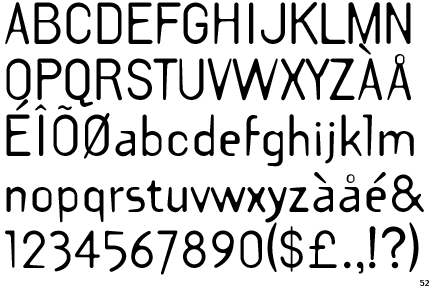
TEMPLATE GOTHIC
BARRY DECK , 1990


RAY GUN
DAVID CARSON 
 1992-95


Carson the end of print. 
using practice to be theoretical - with the two in dialogue constantly. 


provokes thought
forces you to think about why it has been changed and what has changed. 
forced to read and consider. 
unpicking things that are hidden but affect the way you read. 
 
ARCHITECTURE
Using forms and techniques to critique that form.
DANIEL LIBESKIND
PETER EISENMANN
Assume a building will look a certain way.
So uses normal ideas to critique and make people question.

BERNARD TSCHUMI
need to think your way through his par.

in 3 different ways
Anti-authoritarian

"this is how you will read the book"

deconstruction
"how do I read this book?"

JEWISH MUSEUM - DANIEL LIBESKIND
deconstruction is a process for critiquing assumed conventions from within

By using those conventions differently .


DERRIDA - GLAS
designer Richard eckersley
deconstructs subtly what it is to be a book.


Using graphic design to question what it is & how it creates meaning.

postmodernist aswell