
Showing posts with label OUCS205. Show all posts
Showing posts with label OUCS205. Show all posts
Monday, 26 March 2012

Task 5 - The Gaze
‘according to usage and conventions which are at last being questioned
but have by no means been overcome - men
act and women appear. Men look at
women. Women watch themselves being looked at’ (Berger 1972, 45, 47)


Throughout history, men have been noted as the dominant sex, in almost
every culture and at almost every stage of development. Even in the world of
art, until very recently, it was male dominated.
Women have always been objectified; almost all nudes in fine art
throughout history have been female, painted for rich men to admire. Although
today the story is very similar, there is a feeling that women, in art and
advertising are becoming more dominant.
This first image, the Birth of Venus, painted by Alexandre Cabanel in
1863 is a perfect example of the female nude seen throughout history. Lying
backwards with her hands above her head, like a damsel in distress, her pose is
incredibly submissive. Cherubs surrounding her add to the fantastical element
of the painting, men can look upon her in a way that she would never be viewed
in reality.
Historically the female has been submissive and is not entirely present
in the act of being viewed. For example in the Birth of Venus, her gaze is
everted from the viewer, implying she is there only to be looked upon and will
not look back upon you. However contemporary advertising puts women in a much
more dominant position in this process of being viewed.
The Lynx advert above shows the woman scantily clad, looking directly
at the viewer. She is much more a part of this process of being gazed upon and
she is fully aware of it. Her
stance suggests dominance within the ad and her lack of clothing suggests
confidence.
This change in the gaze, may only be slight and advertising and art is
still very much based around the female model, however women now appear to have
power over men as opposed to the other way round. They control the advertising
with their gaze upon the viewer. The objectification of women has never
changed, however the use of the gaze has.
Friday, 9 March 2012
Task 4 - Hyperreality
Hyperreality
is a concept based around simlations, copies of things that existed in reality
used in different contexts. These simulations of reality then become difficult
to distinguish from reality or people take these simulations to be the real, in
turn creating a cycle of simulation and simulacrum that continuously repeats
itself.
The
film industry is based entirely in this idea of simulating reality, to the
point that people often believe what happens in films is the reality because it
is the only way that they have ever experienced it. The Matrix is a film based
around the concepts and theories described by Jean Baudrillard and focuses on
the idea that people live in a world completely constructed from simulations of
reality, or what people perceive to be real. The difference between reality and
its simulations had been blurred to such a point that they had created a
program to replace what was now described as ‘the desert of the real’, quoted
in the film from Baudrillard’s 1981 book Simulacra and Simulations.
Films
surrounding the subject of war, however are what I’d like to suggest are
hyperreal in today’s society, more so than other genres, because of the way in
which these simulations of war are then accepted so readily as the reality. The
majority of films and even games produced about war have very little actual
grounding in war and show incredibly intense, over the top, explosive
depictions of battle. These tend to focus on the visual elements of war, which
they compact into (very) small periods of time, in (very) small spaces, often
all coming down to spectacular endings with a HUGE EXPLOSION. The reality is for the most part very different.
It is
even suggested by certain theorists like Jean Baudrillard and Slavoj Zizek that
the 9/11 attack on the World Trade Centres had ‘parallels with disaster movies’
and was ‘the stuff of popular fantasies long before they actually happened’.
Suggesting that the attacks were simulations of war, acted out in the form of a
terrorist attack.
Sources:
Simulacra
and Simulations – Jean Baudrillard
Media,
War and Postmodernity – Phil Hammond.
Thursday, 8 March 2012
Lecture 12 - Globalisation, sustainability and the media.
Shift towards a global world with one mono-culture
- Increasingly unsustainable
- Ruthless, capitalist global system.
Desire shared by socialists and capitalists
Socialist
- For collectivity
- resources can be shared - unified and working together
Capitalist
- Increases the amount of markets you can tap into
- global markets
Stanford encyclopedia of philosophy
(good source)
Domination
Westernisation of all other cultures
Americanisation
George Ritzer
'McDonaldization'
- Not shared culture. All cultures operate in the same way as America
- Principles and values of American capitalist business dominate other cultures
Marshall McLuhan
- Wrote about developments in technology and how it would change the world.
- New technologies extend our own senses and us as individuals
- Can now hear and see events on a global scale - in the age of communication.
GLOBAL VILLAGE THESIS
- The world would shrink and everyone would know each other. McLuhan thought this shrinking of the world would bring people together
- Definitely not the case
- Almost distances us from events
- de-sensitises us to the pain of others
"Brings us together but tears us apart"
R.Miles 2012
McLuhan was naive
- Thought individualism would become obsolete
DIDN'T!
- Always moving further away from a unified 'Global Village'
Jihad vs McWorld
Problems of Globalization
Sovereignty
- Challenging the idea of National identity
Cultural Imperialism
- Forcing culture on people and making them think in the way you do.
- Mass media is the vehicle for cultural imperialism in the West
Argue that the global village is not integrated community but an assimilated one
Time Warner
- Massive company owning hundreds of smaller companies in the media worldwide
All CNN news controlled by them
Hundreds of disparate things answer back to one CEO at Time Warner
Therefore one voice/view is spread globally
One way of thinking about the world
Media Oligopolies
- Target the world in the amount of money they can make
1. North America
2. Western Europe, Japan & Australia
3. Developing Economies etc, India, China, Brazil, rest of Europe
4. The rest of the world
Utterly dominant American culture spread worldwide
Big Brother - Western program
- Repeated in other cultures around the world
"It's popular, we should be like this"
-Version of Western culture imposed on other cultures. Applies to all media
- the effect of this is cultural assimilation
- People believe they should aim for this culture
Giant system of propaganda for Western Capitalism
Chomsky & Herman 1998
- Manufacturing consent
Ownership - Who they're controlled by
Funding - How they get money
Sourcing - How and where they get information
Flak - People working against them
Anti-communist ideology - Underlying agenda
Rupert Murdoch
- The Sun wins elections not political parties
He controls the power to influence cultures
Nearly 40% of newspapers influenced by this one man
- If the owner has an agenda - the information coming from it will always be flawed
Sourcing
- Papers are only as good as the stories they're allowed to publish
- Questions to people have to be delicate
- cannot be invasive
- most media organisations are funded by advertising
- they cannot push stories that would upset the people funding them
US based - Global Climate Coalition
- directly contradict scare stories of global warming
Information spread in the interests of oil companies. Big capitalist companies
Ideologies
Making others look more evil.
In turn making British views etc look better
Al Gore
- Campaigner for environmentalist views
All solutions he poses for global warming rely on people spending money and buying things
AMERICA AND CHINA DO NOT SUBSCRIBE TO ANYTHING IN THE INTEREST OF THE PLANET, BECAUSE IT IS NOT IN THE INTEREST OF BUSINESS
-Sustainability and growth appear contradictory
BIOX Biofuel Plant . Canada
- Alternative, ' clean ' fuel
- Renewable
- Expensive to produce
- Built the factory in the poorest area of Hamilton, Canada
- Very close to peoples homes who couldn't afford to move.
THE ATTEMPTS TO RIGHT GLOBAL WARMING HAVE MORE DAMAGING EFFECTS ON THE ENVIRONMENT THAN CURRENT SYSTEMS
Greenwashing - branding companies in a way that makes them appear caring, when they're more than likely not.
SUSTAINABILITY IS IMPOSSIBLE UNDER A CAPITALIST SYSTEM AS IT RELIES ENTIRELY ON CONTINUOUS GROWTH
Al Gore - Environmentalists
Radicals - Ecologists
Internet has given people who want to resist the mechanism to do so. As a group
- Activists are mobilising on the internet
- Global resistance
the media is a weapon wielded against us.
But can be used for our own means aswell.
- Increasingly unsustainable
- Ruthless, capitalist global system.
Desire shared by socialists and capitalists
Socialist
- For collectivity
- resources can be shared - unified and working together
Capitalist
- Increases the amount of markets you can tap into
- global markets
Stanford encyclopedia of philosophy
(good source)
Domination
Westernisation of all other cultures
Americanisation
George Ritzer
'McDonaldization'
- Not shared culture. All cultures operate in the same way as America
- Principles and values of American capitalist business dominate other cultures
Marshall McLuhan
- Wrote about developments in technology and how it would change the world.
- New technologies extend our own senses and us as individuals
- Can now hear and see events on a global scale - in the age of communication.
GLOBAL VILLAGE THESIS
- The world would shrink and everyone would know each other. McLuhan thought this shrinking of the world would bring people together
- Definitely not the case
- Almost distances us from events
- de-sensitises us to the pain of others
"Brings us together but tears us apart"
R.Miles 2012
McLuhan was naive
- Thought individualism would become obsolete
DIDN'T!
- Always moving further away from a unified 'Global Village'
Jihad vs McWorld
Problems of Globalization
Sovereignty
- Challenging the idea of National identity
Cultural Imperialism
- Forcing culture on people and making them think in the way you do.
- Mass media is the vehicle for cultural imperialism in the West
Argue that the global village is not integrated community but an assimilated one
Time Warner
- Massive company owning hundreds of smaller companies in the media worldwide
All CNN news controlled by them
Hundreds of disparate things answer back to one CEO at Time Warner
Therefore one voice/view is spread globally
One way of thinking about the world
Media Oligopolies
- Target the world in the amount of money they can make
1. North America
2. Western Europe, Japan & Australia
3. Developing Economies etc, India, China, Brazil, rest of Europe
4. The rest of the world
Utterly dominant American culture spread worldwide
Big Brother - Western program
- Repeated in other cultures around the world
"It's popular, we should be like this"
-Version of Western culture imposed on other cultures. Applies to all media
- the effect of this is cultural assimilation
- People believe they should aim for this culture
Giant system of propaganda for Western Capitalism
Chomsky & Herman 1998
- Manufacturing consent
Ownership - Who they're controlled by
Funding - How they get money
Sourcing - How and where they get information
Flak - People working against them
Anti-communist ideology - Underlying agenda
Rupert Murdoch
- The Sun wins elections not political parties
He controls the power to influence cultures
Nearly 40% of newspapers influenced by this one man
- If the owner has an agenda - the information coming from it will always be flawed
Sourcing
- Papers are only as good as the stories they're allowed to publish
- Questions to people have to be delicate
- cannot be invasive
- most media organisations are funded by advertising
- they cannot push stories that would upset the people funding them
US based - Global Climate Coalition
- directly contradict scare stories of global warming
Information spread in the interests of oil companies. Big capitalist companies
Ideologies
Making others look more evil.
In turn making British views etc look better
Al Gore
- Campaigner for environmentalist views
All solutions he poses for global warming rely on people spending money and buying things
AMERICA AND CHINA DO NOT SUBSCRIBE TO ANYTHING IN THE INTEREST OF THE PLANET, BECAUSE IT IS NOT IN THE INTEREST OF BUSINESS
-Sustainability and growth appear contradictory
BIOX Biofuel Plant . Canada
- Alternative, ' clean ' fuel
- Renewable
- Expensive to produce
- Built the factory in the poorest area of Hamilton, Canada
- Very close to peoples homes who couldn't afford to move.
THE ATTEMPTS TO RIGHT GLOBAL WARMING HAVE MORE DAMAGING EFFECTS ON THE ENVIRONMENT THAN CURRENT SYSTEMS
Greenwashing - branding companies in a way that makes them appear caring, when they're more than likely not.
SUSTAINABILITY IS IMPOSSIBLE UNDER A CAPITALIST SYSTEM AS IT RELIES ENTIRELY ON CONTINUOUS GROWTH
Al Gore - Environmentalists
Radicals - Ecologists
Internet has given people who want to resist the mechanism to do so. As a group
- Activists are mobilising on the internet
- Global resistance
the media is a weapon wielded against us.
But can be used for our own means aswell.
Lecture 10 - Deleuze, Guattari & creativity
Richard Pinhas
Strange music
- sounds come together - disperse - reconfigure
Constructed and contingent nature of social reality
Creativity > generative force
Contrasting 'Rhizomatic' with traditional 'tree-like' thought
Concepts of 'the visual' and 'the actual'
1970s & 80s philosopher and psychologist
Faris May 1968
- student and worker protests
Re-thinking social change - could be ongoing as opposed to a point of revolution/revolt.
Which in Paris' student and worker protests was unsuccessful
Traditional thought - Tree-like
- lines of argument 'branching' out from one central point. trunk.
Alternate structure of thought - Rhizomatic.
- favours creativity/play
Multi-disciplinary construction
re-contextualised
reverberate
Rhizo from the plant form - like tree
Rhizos are like wall climbing plants
Ginger is a rhizo
- growing underground then pushing up shoots
Forms the alternative mode of thought
Linked not through vertical progression like tree. But through jumping between many different ideas
Principles of inter-relationship
Produced ideas between users of a given language system
Dog > log } changing single letters can completely alter the meaning
Draws upon the nature by which meaning is constructed between different language systems.
Embrace our connection with reality around us. Rhizos are creative forces shaping new ways of thinking/practicing
Isa Genzken , Hospital (Ground zero) 2008
Things appear put together provisionally
Found materials
Suggests the possibility of architectural construction that could be reconfigured
Assemblage. Developed by Deleuze and Guattari
Arranging > organising > Putting together
coming together of 'things'
School > example of an assemblage
Home > assemblage
Dinner Party > assemblage
Singing pr humming a tune in order to bring back familiarity to an unfamiliar place
Home not necessarily a house
Places and language and how the two together can be meaningful
"here is your diploma"
- under currents in this statement of duty, get a job... well done, congratulations.
Laden with implicit pre-propositions of what people say and do in these situations.
Statements that enact their meaning
"I do" at a wedding > both an utterance and an action.
Bruce Nauman - good boy, bad boy
Repeating statements that continually change, by very small amounts > single word change each time.
"I", "you", "we"
Language is not just about transmission of messages - it is also about the reply.
Value - power - prejudice
"hoody" - person wearing a hood up. some kind of criminal tendencies.
History of assumptions surrounding 'hoodies'
"hoodies" assembling outside shop
- are judged by everyone passing
- people make assumptions
- area they are then becomes territorialised
- with each judgement, the assemblage changes
Tabloid press
status of teenagers in society change very quickly
Whereas status of the military is fixed
Zaha Hadid
Creates buildings that come together as assemblages
Subjectivation.
Sense of self/identity is not given, it is always under construction.
Ideology
Close to the views of Marxism
( or bears some kind of relation to it)
Some ideologies dominate, or they reflect dominance within society.
- Person owning means of production etc
- relations of dominance
conflictual nature of ideology
"We're all in it together"
Mantra following the banking crisis
repressive state apparatus - the police?
Commuters
- Thrust into the tasks of wage labour.
- Forced to perform as a parent
Have to do your job properly
Have to behave in public } each have recurrence if not.
Have to be thoughtful to partner
How we ought to behave within a given situation
How we as individuals are shaped by society
Schizo analysis
Our psyche is shaped by our relationship to our parents growing up.
Freud is a tree-like thinker
psycho analysis is a practice aswell as a theory
I understand you/ I can treat you
etc
set notion of who a person is
Through role play and discussion and suggestion etc therapists aim to reconfigure who that person is.
Schizophrenia
In the process of breakdown > is the possibility for change and rehabilitation
The unconscious is a factory that continually produces and constructs.
Planting a tree in the mind of the individual.
Socially constructed assemblages
> psychological assemblages
The body without organs
The radical reduction of state to something like a 'loss of self'
Being in the middle of a mosh pit.
Bodies breakdown
Balance and intensive body - variations in amplitude
Loss of linguistic
Feel the body as a singular sensing organ
A STRUCTURE
Loss of awareness of structure that generates the possibility of individual change
Francis Bacon - study of george Dyer, 1969
- Doesn't paint people - paint flesh etc
Body without organs
De-territorialising from identity
Nothing is inevitable > Everything changes
- Change in the term 'banker' and what it connotes to us
Western thought is pre-occupied by identity
Difference for Deleuze and Guattari precedes identity
Even mountains are considered constructions
'real' is the relation between the thing itself and all its constituent parts
synthesis of change and perminance
Any object us a contingent construction
Made up of molecular constituents
Francis Bacon
- Messy studios - full of stuff he used to work from
- the images influenced his own work
Series of tools for strategic thought
Way of understanding how we exist in relation to an ever changing work.
Strange music
- sounds come together - disperse - reconfigure
Constructed and contingent nature of social reality
Creativity > generative force
Contrasting 'Rhizomatic' with traditional 'tree-like' thought
Concepts of 'the visual' and 'the actual'
1970s & 80s philosopher and psychologist
Faris May 1968
- student and worker protests
Re-thinking social change - could be ongoing as opposed to a point of revolution/revolt.
Which in Paris' student and worker protests was unsuccessful
Traditional thought - Tree-like
- lines of argument 'branching' out from one central point. trunk.
Alternate structure of thought - Rhizomatic.
- favours creativity/play
Multi-disciplinary construction
re-contextualised
reverberate
Rhizo from the plant form - like tree
Rhizos are like wall climbing plants
Ginger is a rhizo
- growing underground then pushing up shoots
Forms the alternative mode of thought
Linked not through vertical progression like tree. But through jumping between many different ideas
Principles of inter-relationship
Produced ideas between users of a given language system
Dog > log } changing single letters can completely alter the meaning
Draws upon the nature by which meaning is constructed between different language systems.
Embrace our connection with reality around us. Rhizos are creative forces shaping new ways of thinking/practicing
Isa Genzken , Hospital (Ground zero) 2008
Things appear put together provisionally
Found materials
Suggests the possibility of architectural construction that could be reconfigured
Assemblage. Developed by Deleuze and Guattari
Arranging > organising > Putting together
coming together of 'things'
School > example of an assemblage
Home > assemblage
Dinner Party > assemblage
Singing pr humming a tune in order to bring back familiarity to an unfamiliar place
Home not necessarily a house
Places and language and how the two together can be meaningful
"here is your diploma"
- under currents in this statement of duty, get a job... well done, congratulations.
Laden with implicit pre-propositions of what people say and do in these situations.
Statements that enact their meaning
"I do" at a wedding > both an utterance and an action.
Bruce Nauman - good boy, bad boy
Repeating statements that continually change, by very small amounts > single word change each time.
"I", "you", "we"
Language is not just about transmission of messages - it is also about the reply.
Value - power - prejudice
"hoody" - person wearing a hood up. some kind of criminal tendencies.
History of assumptions surrounding 'hoodies'
"hoodies" assembling outside shop
- are judged by everyone passing
- people make assumptions
- area they are then becomes territorialised
- with each judgement, the assemblage changes
Tabloid press
status of teenagers in society change very quickly
Whereas status of the military is fixed
Zaha Hadid
Creates buildings that come together as assemblages
Subjectivation.
Sense of self/identity is not given, it is always under construction.
Ideology
Close to the views of Marxism
( or bears some kind of relation to it)
Some ideologies dominate, or they reflect dominance within society.
- Person owning means of production etc
- relations of dominance
conflictual nature of ideology
"We're all in it together"
Mantra following the banking crisis
repressive state apparatus - the police?
Commuters
- Thrust into the tasks of wage labour.
- Forced to perform as a parent
Have to do your job properly
Have to behave in public } each have recurrence if not.
Have to be thoughtful to partner
How we ought to behave within a given situation
How we as individuals are shaped by society
Schizo analysis
Our psyche is shaped by our relationship to our parents growing up.
Freud is a tree-like thinker
psycho analysis is a practice aswell as a theory
I understand you/ I can treat you
etc
set notion of who a person is
Through role play and discussion and suggestion etc therapists aim to reconfigure who that person is.
Schizophrenia
In the process of breakdown > is the possibility for change and rehabilitation
The unconscious is a factory that continually produces and constructs.
Planting a tree in the mind of the individual.
Socially constructed assemblages
> psychological assemblages
The body without organs
The radical reduction of state to something like a 'loss of self'
Being in the middle of a mosh pit.
Bodies breakdown
Balance and intensive body - variations in amplitude
Loss of linguistic
Feel the body as a singular sensing organ
A STRUCTURE
Loss of awareness of structure that generates the possibility of individual change
Francis Bacon - study of george Dyer, 1969
- Doesn't paint people - paint flesh etc
Body without organs
De-territorialising from identity
Nothing is inevitable > Everything changes
- Change in the term 'banker' and what it connotes to us
Western thought is pre-occupied by identity
Difference for Deleuze and Guattari precedes identity
Even mountains are considered constructions
'real' is the relation between the thing itself and all its constituent parts
synthesis of change and perminance
Any object us a contingent construction
Made up of molecular constituents
Francis Bacon
- Messy studios - full of stuff he used to work from
- the images influenced his own work
Series of tools for strategic thought
Way of understanding how we exist in relation to an ever changing work.
Lecture 9 - Censorship & truth
-Notions of censorship
-Quality of photograph in rendering truth
-Photographic manipulation
-Censorship of advertising
-Censorship in art & photography
Ansel Adams


-Quality of photograph in rendering truth
-Photographic manipulation
-Censorship of advertising
-Censorship in art & photography
Ansel Adams

Moonrise Hernandez, New Mexico, 1941-42
A given that photographs can be 'improved' be commonly used photographic manipulation.
-software etc
- Digital photography is code that 'exists'

Moon over half dome, 1960
Countless reproductions using different exposures and darkroom techniques to alter their effect.
Manipulation in photography isn't new...
Stalin & Nikolai Yezhov
- Manipulated image in Pravda
Newspaper doctored the news
They censor the news and manipulate it to give you the story they think you should read.
Kate Winslet on GQ Magazine
Making her legs slightly longer...
Images put together in order to sell a story
pictures from Iraq etc.
Viewing allied soldiers in a dim view.
Robert Capa

Death of a loyalist soldier, 1936
Is it real? does it matter?
Up for discussion for a long time. Proved he probably is quite dead.
Also the truth of images can be coloured by the caption they are put with > emotive
Manipulative advertising, 1984
Is it rational or is it suggestive of what people want you to see
Simulacrum - phases of image.
- reflection of a basic reality
- Jean Baudrillard
Peter Turnley
- The unseen Gulf War
photographs documenting the Gulf War
The photos however were approved by the U.S army, so the images are not exactly showing the truth
His book offers all the unpublished images so people had their own opinions and could see what really happened.
Jean Baudrillard - The Gulf War did not take place (1996)
Making the point that it was a war that took place as a simulation of other wars.
- manipulated representation of war
- Strategized media event
Turnley tries to show that it was a real war - taking place - people dying.
Black & white
- 'arty' - colour as opposed to black and white making it more real?
Peter Turnley 1991
Backlash to an image that was very graphic - what does it say about society that we can't see images like it, of real things that are taking place.
Contrived representation of reality.
An-My-Lee - Small Wars
- Fine art photographer turned to capturing war
is there a place for this style of photography or is Turnley's more valid?
"landscape photograph with some tanks in it"
Censorship
- The practice or policy of censoring films, letters or publications
- Obscene - objectionable
- Standards of right and wrong
Theodore Levitt
- The morality of Advertising, 1970
Cadbury's Flake advertising 1969
- orgasmic situations
- 'Inserting' a chocolate bar into her mouth
says more about the viewer than it does about the images themselves.
Oliviero Toscani, United Colours of Benetton, 1992
- Photographer building a career off adverts meant to shock
Cook.G - The Discourse of Advertising
" No such thing as bad publicity"
Balthus, the Golden Years
Does the fact that it's a painting make it acceptable to be graphic?
Bow wow wow record cover
Contains image representative of a painting, however one girl in the band was 14 yet the cover was still released.
Amy Adler - The Folly of defining 'serious' art
- The Miller Test. 1973.
When art starts to become too graphic.
obsenity law.
Sally Mann - Candy Cigarette, 1989
A mother who photographs her children and publishes them.
Should a mother be showing images like this, and what is going on in the images.
Immediate Family, 1984-92
Should she do this or is it different because they are her own children. Family photos...
'A REVOLTING EXHIBITION OF PERVERSION UNDER THE GUISE OF ART '
News of The World
Richard Prince - Spiritual America, 2005
What should we believe? should we be protected from it?
Thursday, 1 March 2012
Monday, 30 January 2012
Lecture 8 - Jean Baudrillard and Postmodernism.
Hyperreality theory.
1960s
production growth
industries
marketing & communism
Bladerunner 1982 - idea of simulacra
MATRIX
What is real?
Reality is turned into blank white canvas filled with constructions
Baudrillard
- early writings grounded in Marxism
Labour
> shaping the environment through industry
Became removed or alienated from the condition.
Universal condition of human experience
Products have 'use value'
- can become commodities
these have 'exchange value'
money...
- abstraction of 'use value'
Relationship to the world becomes indirect.
Directly engaging with & transforming the world around you.
Not possible under capitalism
>said marx.
A mans work becomes an object.
Exchange of labour for production disconnects the labourer from the product.
- weighing products / commodities against all others, and the quantity of money we can exchange them for.
Industrialisation would make production much more effective.
Henry Ford
> automated production line 1913
everyone contributes one element of production along the line.
Post war
Manufacturing boom
assembly line becomes method of production for all commodity items.
John Berger
Publicity as a system proposes we change ourselves an our lives by buying things.
translating words into a language 'people' understand.
Thing statement to human statements.
mpg - high - thrifty
- low - Advertise above thrifty, to those money isn't an issue. thrill seekers etc.
Baudrillard
Advertising codes products
Fitting objects into series
they are then related to individual consumers
Focus Groups.
- Basing advertising upon the information found out from a group of consumers.
Array of advertising messages out there make up a language
needs cohere with product...
Shop Environments
suggest Abundance - affluence
Surplus!
people are all made to desire in the same way
agreement of a given language system
Language . signification of meaning
Tube station
- adverts randomly next to each other (like montage)
cultural condition of hyperreality
'desert of the real'
Twin Towers.
Immune to their surroundings - appear so clearly within the vast city scape.
Media representations affecting & shaping social events.
suggesting that spectacular endings in films etc were sort of the basis for 9/11
post modernity is a game with the leftovers of what has been destroyed
> history has stopped
>No meaning
Material progress has come to an end
American psycho - personification of current social stance.
Patrick Bateman.
1960s
production growth
industries
marketing & communism
Bladerunner 1982 - idea of simulacra
MATRIX
What is real?
Reality is turned into blank white canvas filled with constructions
Baudrillard
- early writings grounded in Marxism
Labour
> shaping the environment through industry
Became removed or alienated from the condition.
Universal condition of human experience
Products have 'use value'
- can become commodities
these have 'exchange value'
money...
- abstraction of 'use value'
Relationship to the world becomes indirect.
Directly engaging with & transforming the world around you.
Not possible under capitalism
>said marx.
A mans work becomes an object.
Exchange of labour for production disconnects the labourer from the product.
- weighing products / commodities against all others, and the quantity of money we can exchange them for.
Industrialisation would make production much more effective.
Henry Ford
> automated production line 1913
everyone contributes one element of production along the line.
Post war
Manufacturing boom
assembly line becomes method of production for all commodity items.
John Berger
Publicity as a system proposes we change ourselves an our lives by buying things.
translating words into a language 'people' understand.
Thing statement to human statements.
mpg - high - thrifty
- low - Advertise above thrifty, to those money isn't an issue. thrill seekers etc.
Baudrillard
Advertising codes products
Fitting objects into series
they are then related to individual consumers
Focus Groups.
- Basing advertising upon the information found out from a group of consumers.
Array of advertising messages out there make up a language
needs cohere with product...
Shop Environments
suggest Abundance - affluence
Surplus!
people are all made to desire in the same way
agreement of a given language system
Language . signification of meaning
Tube station
- adverts randomly next to each other (like montage)
cultural condition of hyperreality
'desert of the real'
Twin Towers.
Immune to their surroundings - appear so clearly within the vast city scape.
Media representations affecting & shaping social events.
suggesting that spectacular endings in films etc were sort of the basis for 9/11
post modernity is a game with the leftovers of what has been destroyed
> history has stopped
>No meaning
Material progress has come to an end
American psycho - personification of current social stance.
Patrick Bateman.
Lecture 7 - Identity.
- Historical conceptions of identity
- 'Discourse' methodology (Foucault)
- 'Fluid' identity theory. (Bauman)
Essentialism
> biological makeup that makes us who we are.
> inner 'essence'
Post modern theories disagree
Physiognomy
Cesare Lambroso
- founder of positivist criminology.
the notion that criminal tendencies are inhereted
Looks at features of the face, suggests that sloped face etc show criminal tendencies. Diagrams explaining this theory show those more likely to have criminal tendencies as African/black men.
This theory almost legitimises racism...attempts to give it some kind of scientific basis.
Phrenology
No real theory of scientific evidence.
Based upon parts of the brain formulating the person you are.
Each section of the brain controls an element of you as a person ( animal etc)
These sections are held in a balance.
If one section is larger in a person then another suffers as a result and will be smaller.
ANGLO - TEUTONIC > seen as racially superior.
Nazism
- Aryan race
blond hair // blue eyes // caucasian.
Heironymous Bosch (1450-1516)
christ carrying the cross.
Chris Ofili
Holy Virgin Mary (1996)
> paints the virgin Mary as a black woman
> exaggerated features.
> paints with elephant dung
Pre-modern identity
-Personal identity is stable - defined by long standing roles.
Modern identity
-Societies offer wider social range. possibility to choose identity rather than being born into it.
People then 'worry'.
Pre modern identity
institutions determined identity.
Marriage, church, monarchy, government, the state, work etc.
Secure identities.
Farm worker
Soldier
factory worker
housewife
gentleman
husband/wife.
Modern identity
Charles Boudelaire - painter of Modern life (1863)
Thorsten Veblen - theory of leisure class ( 1899)
George Simmel - Metropolis of mental life (1903)
People aspire to be a part of the leisure class } paying others to work //rather than in a factory.
'Flaneur' gentleman stroller
Baudelaire > Veblen
Simmel
Trickle down theory > upper classes seen wearing the latest fashions.
> lower classes try to emulate their style > it then become unfashionable because everyone is wearing it > upper class find something new to wear and the cycle repeats itself.
Emulation
Distinction
The 'Mask' of fashion.
Edvard Munch
Simmel suggests that :
Individuals withdraw themselves in order to find peace.
Post modern identity //
Discourse analysis.
-age
-class
-gender } 'Otherness'
-nationality
-race/ethnicity
Class - industrialisation brings on the emergence of the working class.
Mass observation - worktown project ( 1937)


Upper class toffs from London - photographing the working class of Britain. In this instance, Bolton.
Observing them
Northern people observed by Southern people
Humphrey Spender
Trained architect but did photography because he wanted to. There was no need for him to have a proper job because he was so upper class.
Suggest in his photos that the peoples lives are rubbish
> playing with rabbits feet 'cause there's nothing else to play with
Suggesting the people in them are dull.
Martin Parr
Claims hes documenting the world as he sees it...
Romantisising peoples lives.
People argue that his images are condescending } they show an upper class view.
Poke fun at the way people live their lives?
Parr photographs in much the same way as Spencer, with a similar consideration for humour and a way of poking fun at those in the images.
Ascot, 2003, Martin Parr
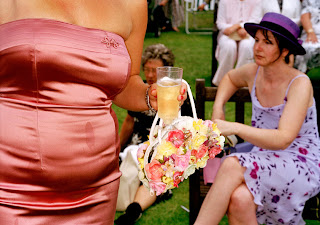 Bauman (2004)
People playing out roles they don't really belong to.
Think of England
Think of Germany
> notion of cliche and representations of the countries.
Alexander Mcqueen
Highland Rape collection (1995-96)
Claims rape of Scotland by the English was the influence for the collection.
It's a jungle out there (1997-98)
Racist?
Vivenne Westwood.
Anglomania - About Englishness
> yet used Tartan, a material synonymous with Scottish-ness.
Highly controversial.
Las Vegas
Multitude of identities in a confused space // why go anywhere else when all the places you'd go are in Las Vegas.
Chris Ofili
No woman, no cry (1998)
Captain shit and the Legend of the black stars (1994)
Making link to elephant dung but also how he feels he may have been perceived as a black teenager growing up in Manchester.
Gillian Wearing
Signs that say what you want them to say and not signs that say what some else wants you to say (1992-93)
Emily Bates- created a dress using her own hair
Gender & sexuality
Wilson. E (1985)
- the fashion industry is the work not of women, but of men.
- a gigantic unconscious hoax, perpetrated on women by the arch villains of the cold war - male homosexuals.
they have a secret hatred of women
Flapper 1952
La Garconne
Masquerade and the mask of femininity
Cindy Sherman > untitled film stills (1977-80)
Making a point of the situation she is in...
objectified.
Sarah Lucas - Au Naturel (1994)
Tracey Emin - Everyone I've ever slept with. (1963-95)
Because a woman has created it, it becomes more acceptable.
Gillian Wearing > Lynn
Post modern condition
- liquid modernity & liquid love.
> identity is constructed through social experience
> Goffman saw life as 'theatre'
Bauman
- identity is something to be invented - can now choose identity
Getting a text message becomes a justification of your existence
Theodore levitt (1970) the morality of advertising
Idea that contemporary life is dull and we use art etc to make it less so.
Barbara Kruger I shop therefore I am . 1987.
Selfridges 2006
Sell out?
Sponsored art show?
Mocking the consumers?
Darley 2000 - visual digital culture
justifying your existence through your phone
Prediction for facebook.
" I like facebook", "I got a shag out of it" (Marty Edwards)
Second life Affairs // marriage
entertainment at the expense of tragic individuals.
- 'Discourse' methodology (Foucault)
- 'Fluid' identity theory. (Bauman)
Essentialism
> biological makeup that makes us who we are.
> inner 'essence'
Post modern theories disagree
Physiognomy
Cesare Lambroso
- founder of positivist criminology.
the notion that criminal tendencies are inhereted
Looks at features of the face, suggests that sloped face etc show criminal tendencies. Diagrams explaining this theory show those more likely to have criminal tendencies as African/black men.
This theory almost legitimises racism...attempts to give it some kind of scientific basis.
Phrenology
No real theory of scientific evidence.
Based upon parts of the brain formulating the person you are.
Each section of the brain controls an element of you as a person ( animal etc)
These sections are held in a balance.
If one section is larger in a person then another suffers as a result and will be smaller.
ANGLO - TEUTONIC > seen as racially superior.
Nazism
- Aryan race
blond hair // blue eyes // caucasian.
Heironymous Bosch (1450-1516)
christ carrying the cross.
Chris Ofili
Holy Virgin Mary (1996)
> paints the virgin Mary as a black woman
> exaggerated features.
> paints with elephant dung
Pre-modern identity
-Personal identity is stable - defined by long standing roles.
Modern identity
-Societies offer wider social range. possibility to choose identity rather than being born into it.
People then 'worry'.
Pre modern identity
institutions determined identity.
Marriage, church, monarchy, government, the state, work etc.
Secure identities.
Farm worker
Soldier
factory worker
housewife
gentleman
husband/wife.
Modern identity
Charles Boudelaire - painter of Modern life (1863)
Thorsten Veblen - theory of leisure class ( 1899)
George Simmel - Metropolis of mental life (1903)
People aspire to be a part of the leisure class } paying others to work //rather than in a factory.
'Flaneur' gentleman stroller
Baudelaire > Veblen
Simmel
Trickle down theory > upper classes seen wearing the latest fashions.
> lower classes try to emulate their style > it then become unfashionable because everyone is wearing it > upper class find something new to wear and the cycle repeats itself.
Emulation
Distinction
The 'Mask' of fashion.
Edvard Munch
Simmel suggests that :
Individuals withdraw themselves in order to find peace.
Post modern identity //
Discourse analysis.
-age
-class
-gender } 'Otherness'
-nationality
-race/ethnicity
Class - industrialisation brings on the emergence of the working class.
Mass observation - worktown project ( 1937)


Upper class toffs from London - photographing the working class of Britain. In this instance, Bolton.
Observing them
Northern people observed by Southern people
Humphrey Spender
Trained architect but did photography because he wanted to. There was no need for him to have a proper job because he was so upper class.
Suggest in his photos that the peoples lives are rubbish
> playing with rabbits feet 'cause there's nothing else to play with
Suggesting the people in them are dull.
Martin Parr
Claims hes documenting the world as he sees it...
Romantisising peoples lives.
People argue that his images are condescending } they show an upper class view.
Poke fun at the way people live their lives?
Parr photographs in much the same way as Spencer, with a similar consideration for humour and a way of poking fun at those in the images.
Ascot, 2003, Martin Parr

People playing out roles they don't really belong to.
Think of England
Think of Germany
> notion of cliche and representations of the countries.
Alexander Mcqueen
Highland Rape collection (1995-96)
Claims rape of Scotland by the English was the influence for the collection.
It's a jungle out there (1997-98)
Racist?
Vivenne Westwood.
Anglomania - About Englishness
> yet used Tartan, a material synonymous with Scottish-ness.
Highly controversial.
Las Vegas
Multitude of identities in a confused space // why go anywhere else when all the places you'd go are in Las Vegas.
Chris Ofili
No woman, no cry (1998)
Captain shit and the Legend of the black stars (1994)
Making link to elephant dung but also how he feels he may have been perceived as a black teenager growing up in Manchester.
Gillian Wearing
Signs that say what you want them to say and not signs that say what some else wants you to say (1992-93)
Emily Bates- created a dress using her own hair
Gender & sexuality
Wilson. E (1985)
- the fashion industry is the work not of women, but of men.
- a gigantic unconscious hoax, perpetrated on women by the arch villains of the cold war - male homosexuals.
they have a secret hatred of women
Flapper 1952
La Garconne
Masquerade and the mask of femininity
Cindy Sherman > untitled film stills (1977-80)
Making a point of the situation she is in...
objectified.
Sarah Lucas - Au Naturel (1994)
Tracey Emin - Everyone I've ever slept with. (1963-95)
Because a woman has created it, it becomes more acceptable.
Gillian Wearing > Lynn
Post modern condition
- liquid modernity & liquid love.
> identity is constructed through social experience
> Goffman saw life as 'theatre'
Bauman
- identity is something to be invented - can now choose identity
Getting a text message becomes a justification of your existence
Theodore levitt (1970) the morality of advertising
Idea that contemporary life is dull and we use art etc to make it less so.
Barbara Kruger I shop therefore I am . 1987.
Selfridges 2006
Sell out?
Sponsored art show?
Mocking the consumers?
Darley 2000 - visual digital culture
justifying your existence through your phone
Prediction for facebook.
" I like facebook", "I got a shag out of it" (Marty Edwards)
Second life Affairs // marriage
entertainment at the expense of tragic individuals.
Thursday, 5 January 2012
Task 3 - Essay Proposal
Subjects.
Swiss design/typography
Modernism
Analysing modernist graphic design, particularly 'Swiss' design by comparing works from modernist design movements from different continents. In this case Swiss and American modernist graphic design.
Initial Research.
Meggs, P.B - 'A History of Graphic Design'
Should give me a good grounding in the history of Graphic Design and also has a section on Modernist graphic design and more importantly the 'International Typographic Style'.
Klanten, R/Bourquin, N/Mareis, C - 'Altitude: Contemporary Swiss Graphic Design'
Will give me an idea of the development and progression of 'Swiss' design into the 21st Century and also how the 'International Typographic Style' has affected contemporary practice.
Hollis, R - 'Swiss Graphic Design: The Origins and Growth of an International Style, 1920-1965'
De Jong, C.W - 'Jan Tschichold, Master Typographer: His Life, Work and Legacy'
Muller, L/Rand, P - 'Josef Muller-Brockmann: Pioneer of Swiss Graphic Design'
Swiss design/typography
Modernism
Analysing modernist graphic design, particularly 'Swiss' design by comparing works from modernist design movements from different continents. In this case Swiss and American modernist graphic design.
Initial Research.
Meggs, P.B - 'A History of Graphic Design'
Should give me a good grounding in the history of Graphic Design and also has a section on Modernist graphic design and more importantly the 'International Typographic Style'.
Klanten, R/Bourquin, N/Mareis, C - 'Altitude: Contemporary Swiss Graphic Design'
Will give me an idea of the development and progression of 'Swiss' design into the 21st Century and also how the 'International Typographic Style' has affected contemporary practice.
Hollis, R - 'Swiss Graphic Design: The Origins and Growth of an International Style, 1920-1965'
- 'Graphic Design: a Concise History'
An entire book about Swiss graphic design should give me all the information I need an a really strong idea of its defining features and beginnings. A concise history, very much like Meggs' 'History of Graphic Design' should inform my knowledge of general Graphic Design.
De Jong, C.W - 'Jan Tschichold, Master Typographer: His Life, Work and Legacy'
- 'Sans Serif'
One of the defining characters in the development of this style both in terms of type design and the use of design and grids in typographic layout.
Muller, L/Rand, P - 'Josef Muller-Brockmann: Pioneer of Swiss Graphic Design'
Another of the Swiss design movements defining practitioners, Useful to learn a little about them and the ideas that the based their practice on.
Saturday, 10 December 2011
Task 2 - Benjamin & Mechanical Reproduction.
.jpg)
Barbara Kruger
I shop therefore I am
1987

Sale promotions
2006
Walter
Benjamin was a Marxist philosopher who looked in incredible detail at the idea
of reproduction and the effect that it has on the value of an original work, in
terms of art. However ideas from his theories can be applied very easily to
works of graphic design in the same way.
The first
thing of note from the text is the mention of the way people critique and look
upon art, and the idea that this has never changed, so people still view art
with ideas of creativity, genius, value and mystery in mind. All these are
traits of the creative genius that are intrinsically related to the work of
art.
I chose this
Barbara Kruger work as it’s a piece of design that has been reproduced and
imitated massively over the years and is a great example of design in the age
of mechanical reproduction. Benjamin mentions that,’ In principle a work of art
as always been reproducible’ and artifacts could always be ‘imitated by men’,
however I find the idea that with mechanical reproduction ’the work of art
reproduced becomes the work of art designed for reproducibility’ very
interesting.
The original
work by Kruger was a silk screen print, just like photographic negatives, many
copies, all differing slightly can be produced from one screen, it is most
likely that these would have been in a limited print run. However Kruger’s work
went on to be used as a slogan on many different items, most notably she was
commissioned by Selfridges to produce a range of promotional material. By doing
so, the aura of the work shrivels, the idea that the work was produced by a
creative genius is also somewhat lost, and the idea that owning an original
print from the first run becomes much more impressive.
Even the most
perfect copy of Kruger’s prints therefore is always going to be ‘lacking in one
element: its presence in time and space, its unique existence and the place
where it happens to be’. By imitating the style and creating copies the time at
which it was created becomes unimportant and the placement of these copies
takes the original work and concept behind it completely out of context.
Thursday, 8 December 2011
Lecture 6 - Cities & film.
Looking at :
> the city in modernism
> the city as a public & as a private space.
> the city in post modernism.
George Simmel (1858-1918)
- Dresden exhibition 1903
- Simmel is asked to lecture
> urban sociology
- the resistance of the individual to being levelled, swallowed up in the social-technological mechanism.
Louis Sullivan (1856-1924)
- Architect
- Credited with being the creator of the modern sky scraper
Guaranty building
- ornate // decorative exterior
(despite appearance)

 building was split :
4 interior zones
Basement - public area - office zone
organised // ordered environment
3 types of exterior block corresponding with the three visible exterior zones.
America as an upward moving, land of opportunity.
Manhatta (1921) Paul Strand
Documentary film > loose / no narrative
Explores the relationship between photography and film, minimal camera movement.
Charles Sheeler
ford plant > river rouge > detroit
{fordism}
 Production line gains maximum productivity with minimum effort via repetitive/robotic human activity.
Modern times (1936) Charlie Chaplin
body is consumed/swallowed by the factory
Stock market crash of 1929
>immigrant population hit first > then laborers
Man with a movie camera (1929)
noted for it's range of video/movie techniques
celebration of industrialisation and everything that goes with it.
Flaneur
Stroller / lounger / saunterer
A person who walks the city to experience it.
Both apart from, and a part of the crowd.
Walter Benjamin
> bit of a flaneur
> Adopts the concept of and urban observer as an analytical tool and as a lifestyle.
Susan Sontag
> the photographer as a flaneur
> Photographer is merely an 'armed' flaneur
Flaneuse
Female wanderer.
Susan Buch-Morss
Bag lady or prostitute.
Arbus // Hopper


cities of the future > Metropolis (1929)
> the city in modernism
> the city as a public & as a private space.
> the city in post modernism.
George Simmel (1858-1918)
- Dresden exhibition 1903
- Simmel is asked to lecture
> urban sociology
- the resistance of the individual to being levelled, swallowed up in the social-technological mechanism.
Louis Sullivan (1856-1924)
- Architect
- Credited with being the creator of the modern sky scraper
Guaranty building
- ornate // decorative exterior
(despite appearance)


4 interior zones
Basement - public area - office zone
organised // ordered environment
3 types of exterior block corresponding with the three visible exterior zones.
America as an upward moving, land of opportunity.
Manhatta (1921) Paul Strand
Documentary film > loose / no narrative
Explores the relationship between photography and film, minimal camera movement.
Charles Sheeler
ford plant > river rouge > detroit
{fordism}

Modern times (1936) Charlie Chaplin
body is consumed/swallowed by the factory
Stock market crash of 1929
>immigrant population hit first > then laborers
Man with a movie camera (1929)
noted for it's range of video/movie techniques
celebration of industrialisation and everything that goes with it.
Flaneur
Stroller / lounger / saunterer
A person who walks the city to experience it.
Both apart from, and a part of the crowd.
Walter Benjamin
> bit of a flaneur
> Adopts the concept of and urban observer as an analytical tool and as a lifestyle.
Susan Sontag
> the photographer as a flaneur
> Photographer is merely an 'armed' flaneur
Flaneuse
Female wanderer.
Susan Buch-Morss
Bag lady or prostitute.
Arbus // Hopper

Hoppers 'Automat' (1927)

Diane Arbus' 'Woman at a counter smoking N.Y.C' (1962)
Observed moments with sense that something has just happened
Sophie Calle - Suite Venitienne (1980)
About the experience of the city
Accompanied by a text explaining her relationship with the man in the pictures.
Venice > labyrinth of streets and alleyways
Good place for a filthy stalker...I mean...photographer
Don't look now (1973) <film>
Nicholas Roeg
The Detective (1980)
Having private detective following her
> wants to provide photographic evidence of her existence
Cindy Sherman ( 1977-80)
Typical representation of women in the city
Pictures were intended to be mysterious
typical of post modernism { no concrete location (could be anywhere) }
Weegee (arthur felig)
Documented the dark side of city
Following and documenting police detectives.
With a mobile darkroom so he could develop pictures and be the first to the press.

The Naked City
Noire tradition
L.A. Noire set in 1947 Los Angeles (2011)
Homage to the visual style of film noire.
cities of the future > Metropolis (1929)
Blade runner (1989 > depicting 2019)
Lorca di Corcia - heads (2001) NY
Not seen by the people he photographs
Set off like a trip flash from people walking past.
Sense of height & drama
A man in one of his photos objected to the use of his image on religious grounds
The image was subsequently allowed.
Anything that happens in the city is open to artistic interpretation. Private is taken back.
Walker Evans - Many are called (1938)
Intensely private moments shot unaware.
Postmodern city
"the outside becoming the inside" Ed Soja
Being lost in architecture
Confusing/difficult to navigate
Joel Meyerowitz
Postmodern city in photography. Chaotic. Busy
Citizen Journalism > the end of the flaneur?
Impossible to be a detached observer
9/11. destroyed in a mental capacity aswell.
Destruction of the twin towers represents a destruction of the American Dream.
Adam Beezer (2001)
involved in the tragedy. Pictures from a phone camera.
Returns photography to it's roots // merely to document events.
Surveillance city
Coming together of photography & film on the street.
Monday, 28 November 2011
Lecture 3 - Marxism & Design activism
" The philosophers have only interpreted the world, in various ways; the point, however, is to change it."
K. Marx
He's saying there should be synthesis between thinking and practice.
Marxist is: Communist
-Political manifesto outlining what Marx saw as the best way to organise society and the way to go about achieving it.
-A philosophical approach to social science, developing a new way of looking at the role of society in determining human behaviour.
Capitalist is:
Society that we live in (in the West)
-Control of means of production is held by a few individuals.
-Everyone else works for money
-Revolves around a market (buy & sell)
-Controlled through the exchange of money/currency
-Makes us compete - being better due to being at the top of society.
{Accidental heirarchy in the market}
Communist evolution.
-Primitive communism
-Slave society
-Feudalism
-Capitalism
-Socialism
-Communism - (Ideally) - A classless, stateless society...
Marx thought the huge difference in wealth would mean workers would revolt.
Due to the unfairness of their exploitation.
Materialist philosopher.
Marx argues society can be split into two.
BASE
Forces of production - materials, tools, workers...
relations of production - employer/employee, class, master/slave
everything is a result of these & everything can be traced back to these factors.
SUPER STRUCTURE
Social institutions
Base > determines content & form > Superstructure > reflects & legitimises > Base
Could be likened to the education system
bosses & workers
Teachers & students
Bourgeoisie exploit the proletariat
Base shapes the superstructure
Superstructure maintains and legitimises the base.
Marx (1857) 'Contribution to the critique of political economy'
Society defines who you are
Forced into relations we have no control of.
All determines consciousness produced by this concept of base/superstructure.
Changing the base will change the politics, attitudes, art, culture etc.
Pyramid of capitalist system 1917
ruling class - aristocracy
the state > a committee for managing the common affairs.
Controlling the way subjects think
> through ideology
> organised religion
Marxist reading > religion is the ultimate form of mental control.
Ideology - system of ideas & beliefs.
- masking, distorting or selectively choosing ideas through creation of 'false consciousness'
Ideological mechanisms operating around us cause this false consciousness.
Ideology usually emerges from the ruling class
Yet everyone else begins to believe this is their view.
'Religion is the opiate of the masses'
Art as ideology
- Only the rich make art
- Only men make art
- White
> Bought & dictated by rich people
Won't reflect the views of the working class.
Vladimirski 'Roses for Stalin' (1949)
 Completely warped view on Stalin as a leader, dictated by him.
Lincoln Cathedral - art is always ideological
Althusser (1970) 'Ideology and ideological state apparatuses'
ideology is a relationship
A practice through which we live our lives.
Offers reasons for why this may happen
Female nudes > male artist > coincidence? I think not.
Ideological state apparatus.
Media
> Majority is owned by 8 super rich people / reflects their views.
> Very invasive.
The Times > upper class - sophisticated stories - worded differently.
Daily Star > ideological assumption that the working class are only interested in tits & football
Self-fulfilling prophecy > becomes true as they are fed only that...
Each paper shows simply a judgement on the cover & in the headlines.
TV ideology.
Darcus Howe - respected broadcaster and writer.
Explains social reasons > accused of being a rioter.
Berger ,'Ways of seeing' 1972
Wonderbra adverts.
Tricked into thinking that through buying we are gaining status in society. However we are actually getting poorer and making someone else richer.
Commodity fetishism
The object then takes on the idea that it's cool, not the person using/wearing it.
Garbage of New York City

7% of the population own 84% of our wealth.
F. Fukuyama (1992) 'The End of History'
Gandhi > society is judged on how it treats its weakest members.
social movement starting - largely through social media.
Adbusters
> culture jamming
- billboard > do something that changes the message entirely
> will in turn make people believe your message
Sao Paolo banned advertising as it's visual noise.
Art and design is conditioned by society.
K. Marx
He's saying there should be synthesis between thinking and practice.
Marxist is: Communist
-Political manifesto outlining what Marx saw as the best way to organise society and the way to go about achieving it.
-A philosophical approach to social science, developing a new way of looking at the role of society in determining human behaviour.
Capitalist is:
Society that we live in (in the West)
-Control of means of production is held by a few individuals.
-Everyone else works for money
-Revolves around a market (buy & sell)
-Controlled through the exchange of money/currency
-Makes us compete - being better due to being at the top of society.
{Accidental heirarchy in the market}
Communist evolution.
-Primitive communism
-Slave society
-Feudalism
-Capitalism
-Socialism
-Communism - (Ideally) - A classless, stateless society...
Marx thought the huge difference in wealth would mean workers would revolt.
Due to the unfairness of their exploitation.
Materialist philosopher.
Marx argues society can be split into two.
BASE
Forces of production - materials, tools, workers...
relations of production - employer/employee, class, master/slave
everything is a result of these & everything can be traced back to these factors.
SUPER STRUCTURE
Social institutions
Base > determines content & form > Superstructure > reflects & legitimises > Base
Could be likened to the education system
bosses & workers
Teachers & students
Bourgeoisie exploit the proletariat
Base shapes the superstructure
Superstructure maintains and legitimises the base.
Marx (1857) 'Contribution to the critique of political economy'
Society defines who you are
Forced into relations we have no control of.
All determines consciousness produced by this concept of base/superstructure.
Changing the base will change the politics, attitudes, art, culture etc.
Pyramid of capitalist system 1917
ruling class - aristocracy
the state > a committee for managing the common affairs.
Controlling the way subjects think
> through ideology
> organised religion
Marxist reading > religion is the ultimate form of mental control.
Ideology - system of ideas & beliefs.
- masking, distorting or selectively choosing ideas through creation of 'false consciousness'
Ideological mechanisms operating around us cause this false consciousness.
Ideology usually emerges from the ruling class
Yet everyone else begins to believe this is their view.
'Religion is the opiate of the masses'
Art as ideology
- Only the rich make art
- Only men make art
- White
> Bought & dictated by rich people
Won't reflect the views of the working class.
Vladimirski 'Roses for Stalin' (1949)

Lincoln Cathedral - art is always ideological
Althusser (1970) 'Ideology and ideological state apparatuses'
ideology is a relationship
A practice through which we live our lives.
Offers reasons for why this may happen
Female nudes > male artist > coincidence? I think not.
Ideological state apparatus.
Media
> Majority is owned by 8 super rich people / reflects their views.
> Very invasive.
The Times > upper class - sophisticated stories - worded differently.
Daily Star > ideological assumption that the working class are only interested in tits & football
Self-fulfilling prophecy > becomes true as they are fed only that...
Each paper shows simply a judgement on the cover & in the headlines.
TV ideology.
Darcus Howe - respected broadcaster and writer.
Explains social reasons > accused of being a rioter.
Berger ,'Ways of seeing' 1972
Wonderbra adverts.
Tricked into thinking that through buying we are gaining status in society. However we are actually getting poorer and making someone else richer.
Commodity fetishism
The object then takes on the idea that it's cool, not the person using/wearing it.
Garbage of New York City

7% of the population own 84% of our wealth.
F. Fukuyama (1992) 'The End of History'
Gandhi > society is judged on how it treats its weakest members.
social movement starting - largely through social media.
Adbusters
> culture jamming
- billboard > do something that changes the message entirely
> will in turn make people believe your message
Sao Paolo banned advertising as it's visual noise.
Art and design is conditioned by society.
Task 1 - Panopticism
Panopticism is
a theory of social control outlined by Michel Foucault in his book, Discipline
and Punish, and is based around an idea of surveillance developed during a
period when institutions such as asylums, penitentiaries and reformatories were
in their earliest forms. It relies entirely on the reformation of individuals
captive through controlling them mentally.
The Panopticon
(Jeremy Bentham, 1791) became ‘the architectural figure of this compostition’.
Foucault states that ‘it reverses the principle of the dungeon’, preserving
only its primary function of enclosure. Inmates are kept in cells individually,
which surround a central tower that is not lit. Each cell is lit from the
outside wall, meaning that the inmates can always be seen from the central
tower, but cannot see into the tower themselves. The major effect this has is
‘to induce in the inmate a state of conscious and permanent visibility that
assures the automatic functioning of power’.
There are many
elements of contemporary society that could be seen as remaining elements of
this panoptic form of social control, one of the major examples being CCTV
cameras. It is thought that people are filmed more than 300 times a day by
these cameras and we are constantly reminded of this fact through the media.
They are always present where ever you are so it is evident that one could
always see you. However like the central tower in the panopticon it is unclear
as to whether you’re actually being watched by anyone at the other end of the
camera; ’power should be visible yet unverifiable’.
This means that people act in the way that they believe they should
act if they are being watched, whether they are or not. CCTV cameras also have
the effect of deterrence in their positioning, and the signs that are used to
warn people of their presence, as soon as someone is made aware that they could
be under surveillance they will act as they believe they should, becoming, as
Foucault described, a ‘docile body’. This also means, that often the cameras
don’t have to work, as it is impossible to tell whether they are or not, and it
is the possibility that you could be being watched that makes you behave in
such a way. The sign warning you of the camera and the actual presentation of
the camera therefore becomes more important than itself due to the effect of ‘self-regulation’
that this instills upon the person.
Sunday, 6 November 2011
Seminar #1 - Panopticism
FOUCAULT.
Panopticon - Jeremy Bentham - 1791
Psychological effect
Internalise the idea that you're always being watched / under surveillance
-Makes you behave in the way you THINK people believe you should
-Most lunatic asylums used the panoptic structure. Prisons still around with this design
-Can be found everywhere
Key features
-Seperated/isolated - can conspire/talk/relate to other there if they aren't isolated
Designed as a sort of laboratory to monitor behaviour.
- Invisibility/visibility - inmates must believe that they are permanently on view
the person viewing them must always be invisible
Central tower is there as a reminder to inmates that someone with power could be watching... this prevents people from doing things wrong through fear.
"invisibility of power"
-Productivity - was designed to make people more productive
not go crazy...
Efficient reform of behaviour.
CCTV cameras - not panoptic if they are hidden but constantly recording / stealth recording.
When they are made visible .e.g. the yellow signs about the signs become more important than the cameras themselves.
Open plan offices - where the boss can always look over people working.
People are less likely to procrastinate.
Social networking & online media - measure yourself against people and act in a way that you think they will like.
- constantly visible to the world
- productive because people bring business to the company without realising.
Docile Bodies
-productive
-obedient
-self-regulating self-monitor <> self-correct
They are created by modern disciplinary society
modern > shift from physical control > mental control
Often spectacular & humiliating physical control...
Although panopticism is a form of mental control, it also controls the body physically.
Foucault said :
"Power is a relationship between people" A <> B
Which works both ways...
Teacher has qualification - knowledge - status allowing him to control&discipline his pupils.
> this relies on his pupils allowing this, and not resisting to his discipline.
Media - TV programs - Films.
Display perfect situations - ideals
-perfect bodies
-perfect lives etc
people blindly follow and in turn are productive in a way thats beneficial to the company.
Panopticon - Jeremy Bentham - 1791
Psychological effect
Internalise the idea that you're always being watched / under surveillance
-Makes you behave in the way you THINK people believe you should
-Most lunatic asylums used the panoptic structure. Prisons still around with this design
-Can be found everywhere
Key features
-Seperated/isolated - can conspire/talk/relate to other there if they aren't isolated
Designed as a sort of laboratory to monitor behaviour.
- Invisibility/visibility - inmates must believe that they are permanently on view
the person viewing them must always be invisible
Central tower is there as a reminder to inmates that someone with power could be watching... this prevents people from doing things wrong through fear.
"invisibility of power"
-Productivity - was designed to make people more productive
not go crazy...
Efficient reform of behaviour.
CCTV cameras - not panoptic if they are hidden but constantly recording / stealth recording.
When they are made visible .e.g. the yellow signs about the signs become more important than the cameras themselves.
Open plan offices - where the boss can always look over people working.
People are less likely to procrastinate.
Social networking & online media - measure yourself against people and act in a way that you think they will like.
- constantly visible to the world
- productive because people bring business to the company without realising.
Docile Bodies
-productive
-obedient
-self-regulating self-monitor <> self-correct
They are created by modern disciplinary society
modern > shift from physical control > mental control
Often spectacular & humiliating physical control...
Although panopticism is a form of mental control, it also controls the body physically.
Foucault said :
"Power is a relationship between people" A <> B
Which works both ways...
Teacher has qualification - knowledge - status allowing him to control&discipline his pupils.
> this relies on his pupils allowing this, and not resisting to his discipline.
Media - TV programs - Films.
Display perfect situations - ideals
-perfect bodies
-perfect lives etc
people blindly follow and in turn are productive in a way thats beneficial to the company.
Tuesday, 1 November 2011
Lecture 2 - 'Technology will liberate us'
Digital currents - Margot lovejoy
The art in the age of mechanical reproduction - Walter Benjamin (1936)
Art in the age of mass media - John Walter
Simulacra & simulation - Jean Baudrillard (1981)
Implications of technology on different design areas
Technological conditions can affect the collective consciousness
- materialism // it's effect on society.
Triggers important changes in cultural development
By copying something - mimicking - it becomes a work of art in itself, because it has been altered by the copying process . It's a work on its own // image representation.
Relationship between art, design & media can be summed up by the doodles on the previous page, copying an image three times from an original sketch, each one differs from the last.
MACHINE AGE - modernism
Walter Benjamin
- commited suicide after the war
- the age of technology and art
- A duality expressing the zeitgeist
- Dialectical due to the copy, reproductive nature and the role of the original
-The 'aura' and uniqueness of art
Never would have had to think about this without the emergence of technology and developments in reproduction processes and quality.
Photography is the beginning of the technological art, art/design relationship.
- Isn't only what you see // photography creates multiple viewing points
Dziga Vertov - Man with a movie camera (1929)

The cameras eye has a variable gaze.
represents technological progress and faith in it.
Paul Valery
Moholy Nagy
-Photograms
Early experiments with photographic technology
Benjamin and two parallels
Freud & Marx
Freud - obsessed with the subconscious and the material aspects of technology
Marx - Looked at the economics of art - economics & value of a piece.
the value of art can change because of consumer nature due to endorsement etc
Consumerism & reproduction can add value to art
Celebrity-ism adds further.
"photography overturned the judgement seat of art"
Margot Lovejoy
How technology can express deepest subconscious
-virtual realities/surrealism
Kineticism
-Capturing movement - Etienne Joules Maret
images of the moving body , 'chronophotography' 1888 was the forefather to cinematography.

Explores how time - duration - space can be depicted in art and photography through the development of technology.
De-materialisation of art
-moving image - recorded image moves away from form and object and become JUST IMAGE
This makes it easier to copy / reproduce.
Richard Hamilton - 1922
- collage
technology to create image
images are ordered, coded and styled
beginning of art and design merging.
-Printed image is part of everything.
Karl Marx & techology
- Technological determinism
- believes theres a logical relationship between economical production & social factors.
- alienation - works as a tool
-technology drives history
-technology and division of labour
-materialist view of history
-technology, capitalism & production
-social alienation of people from aspects of human nature as a result of capitalism.
alienated from distinctive creativity and community
ELECTRONIC AGE - post modernism
post modern & post machine
- Many electronic works were still made with a modern aesthetic
- Emergence of information & conceptual works.
- Computer is a natural metaphor.
- Spirit of openness to industrial techniques - much more cased in consumerism & materialism
- Collaborations in art & science.
- Boundaries are broken between distinct areas of art as a result of technology.
Chalayan...
Conceptualisation of fashion
divergence of factors
>Douglas Rosenberg - Falling/falling

-Electronic/video work showing collaborations between many areas of art & design
video itself becomes an object, something that can be displayed in an exhibition.
>Douglas Rosenberg - Venus Flow

Shift in attitude for discovery of post modern age
Simulation - reflection of a profound reality.
A copy of something real...
Simulacrum states a simulation then becomes a work in its own right.
Real > illusion
Original > copy
Distorts profound reality.
yet can become reality in its own right, and doesn't need to appear realistic. fantastic...
ONE CAN REPLACE ANOTHER
Word of mouth masks the absence of the thing itself > so it is taken as fact / reality.
Nam June Paik
Plays with the idea of real and virtual
> Two go hand in hand
> whos watching who?
John Walker (2001)
criticises the use -art and mass media.
-art in advertising
-artists as celebrity
(Andy Warhol)
DIGITAL AGE
- Digital potential leads to multimedia productions
- Technological reproduction of all images so they are addressed by the computer...
Jenny Holzer - transforms through projection.
Blue tilt (2004)

Baltic (2004)

Extension of gallery space beyond its actual size... to the outside...
Frank Gillette
the human race machine
Developed technology for morphing faces . Collaborated with the FBI
Multimedia work
-Interactivity
-Performance
-Transdisciplinary
-Time, space and motion explored in art & design, also as art
-Collaborations
Hyper-real - reality by proxy.
- art comments on ideology of everyday life
- technology blurs the line between production of fine art & commercial design production
- art can be expressive or progressive.
The art in the age of mechanical reproduction - Walter Benjamin (1936)
Art in the age of mass media - John Walter
Simulacra & simulation - Jean Baudrillard (1981)
Implications of technology on different design areas
Technological conditions can affect the collective consciousness
- materialism // it's effect on society.
Triggers important changes in cultural development
By copying something - mimicking - it becomes a work of art in itself, because it has been altered by the copying process . It's a work on its own // image representation.
Relationship between art, design & media can be summed up by the doodles on the previous page, copying an image three times from an original sketch, each one differs from the last.
MACHINE AGE - modernism
Walter Benjamin
- commited suicide after the war
- the age of technology and art
- A duality expressing the zeitgeist
- Dialectical due to the copy, reproductive nature and the role of the original
-The 'aura' and uniqueness of art
Never would have had to think about this without the emergence of technology and developments in reproduction processes and quality.
Photography is the beginning of the technological art, art/design relationship.
- Isn't only what you see // photography creates multiple viewing points
Dziga Vertov - Man with a movie camera (1929)

The cameras eye has a variable gaze.
represents technological progress and faith in it.
Paul Valery
Moholy Nagy
-Photograms
Early experiments with photographic technology
Benjamin and two parallels
Freud & Marx
Freud - obsessed with the subconscious and the material aspects of technology
Marx - Looked at the economics of art - economics & value of a piece.
the value of art can change because of consumer nature due to endorsement etc
Consumerism & reproduction can add value to art
Celebrity-ism adds further.
"photography overturned the judgement seat of art"
Margot Lovejoy
How technology can express deepest subconscious
-virtual realities/surrealism
Kineticism
-Capturing movement - Etienne Joules Maret
images of the moving body , 'chronophotography' 1888 was the forefather to cinematography.

Explores how time - duration - space can be depicted in art and photography through the development of technology.
De-materialisation of art
-moving image - recorded image moves away from form and object and become JUST IMAGE
This makes it easier to copy / reproduce.
Richard Hamilton - 1922
- collage
technology to create image
images are ordered, coded and styled
beginning of art and design merging.
-Printed image is part of everything.
Karl Marx & techology
- Technological determinism
- believes theres a logical relationship between economical production & social factors.
- alienation - works as a tool
-technology drives history
-technology and division of labour
-materialist view of history
-technology, capitalism & production
-social alienation of people from aspects of human nature as a result of capitalism.
alienated from distinctive creativity and community
ELECTRONIC AGE - post modernism
post modern & post machine
- Many electronic works were still made with a modern aesthetic
- Emergence of information & conceptual works.
- Computer is a natural metaphor.
- Spirit of openness to industrial techniques - much more cased in consumerism & materialism
- Collaborations in art & science.
- Boundaries are broken between distinct areas of art as a result of technology.
Chalayan...
Conceptualisation of fashion
divergence of factors
>Douglas Rosenberg - Falling/falling

-Electronic/video work showing collaborations between many areas of art & design
video itself becomes an object, something that can be displayed in an exhibition.
>Douglas Rosenberg - Venus Flow

Shift in attitude for discovery of post modern age
Simulation - reflection of a profound reality.
A copy of something real...
Simulacrum states a simulation then becomes a work in its own right.
Real > illusion
Original > copy
Distorts profound reality.
yet can become reality in its own right, and doesn't need to appear realistic. fantastic...
ONE CAN REPLACE ANOTHER
Word of mouth masks the absence of the thing itself > so it is taken as fact / reality.
Nam June Paik
Plays with the idea of real and virtual
> Two go hand in hand
> whos watching who?
John Walker (2001)
criticises the use -art and mass media.
-art in advertising
-artists as celebrity
(Andy Warhol)
DIGITAL AGE
- Digital potential leads to multimedia productions
- Technological reproduction of all images so they are addressed by the computer...
Jenny Holzer - transforms through projection.
Blue tilt (2004)
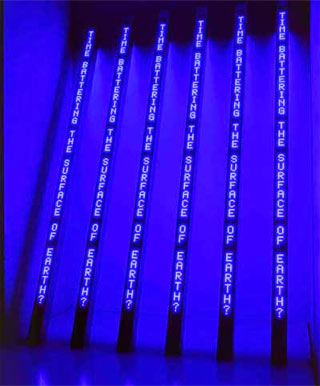
Baltic (2004)

Extension of gallery space beyond its actual size... to the outside...
Frank Gillette
the human race machine
Developed technology for morphing faces . Collaborated with the FBI
Multimedia work
-Interactivity
-Performance
-Transdisciplinary
-Time, space and motion explored in art & design, also as art
-Collaborations
Hyper-real - reality by proxy.
- art comments on ideology of everyday life
- technology blurs the line between production of fine art & commercial design production
- art can be expressive or progressive.
Monday, 31 October 2011
Lecture 1 -Institutions and institutional power - panopticism
1791 - The Panopticon - Foucault saw this as a metaphor for discipline & social control.
MICHEL FOUCAULT
(1926 - 1984)
- Madness & civilization
- Discipline & punish : the birth of the prison.
Both writings survey the rise of institutions & their power.
Madness & civilization
- The great confinement (late 1600s)
> beforehand, mad people, those other than the norm were almost accepted i.e the village idiot...
- Those who were deemed not useful to society were put into 'houses of correction'
> this wasn't just the insane, included criminals, single mothers, unemployed , the idle.
> they were forced to work, through threats and violence
- People began to see these 'houses of correction as a gross error'
- The combination of people, the mad, criminals etc... began to corrupt everyone else in the institutions.
Specialized institutions then began to crop up.
Asylums for the insane
> people were controlled by being treated like minors/children
> made to work by giving them rewards for doing well
* gold star
This marked a shift from physical control to mental control
- which still goes on.
& the emergence of specialists - doctors - psychiatrists
these were there to legitimaise the institutions
Internalised responsibility
>shift from someone else controlling them, to their own conscience.
Deviants used to be punished in the most humiliating / violent / public manor possible
GUY FAWKES
- This was meant not to correct their behavior but to control them, by showing what will happen if they do wrong.
Disciplinary society & disciplinary power
Foucault describes discipline as a technique of modern social control
JEREMY BENTHAM'S PANOPTICON
proposed 1791 but never actually made.
- Bentham thought it could have multiple functions > school > asylum > but mostly... a prison.
A circular construction with rooms around the outside and a central tower with a view of all the rooms.
Each room is back lit so that the subject is clearly visible.
The central tower is in darkness so that the inmates cannot see into the central tower.
Presidio, Cuba applies the same principle - a real prison!
Inmates are permanently on display
and permanently isolated
They know they are being watched but are not able to verify it due to the central tower (representing institutional power) not being lit
> the effect this has is that inmates will always behave in the way they think they should if they're being watched.
> because of the belief that they are always under scrutiny.
> people in turn begin to control their own behaviour.
Eventually - there didn't need to be guards in the tower because the physiological effect brought on just from believing that they were being watched was enough.
Perfect mechanism for control.
- People build up internal discipline
foucault called it a "machine for the automatic functioning of power"
The panopticon also allowed for measured performance of inmates - another mechanism of social control
They then assumed responsibility for their own actions > making them more productive.
it's to do with the arrangement of the space > allowing for scrutiny by the institution and pushes production from the worker/inmates/students...
-reforms prisoners
-helps treat patients
PANOPTICISM
this is the emergence (for foucault) of a new model for control.
panopticism is about training. training the minds of the people under scrutiny.
RELIES ON THE KNOWLEDGE YOU'RE ALWAYS BEING WATCHED, AND ARE AWARE OF IT. IN TURN MAKES YOU WORK HARDER BECAUSE YOU THINK THAT YOU'LL BE CAUGHT OUT.
Examples of panopticism in practice.
-Open plan office
The Office - Ricky Gervais puts on a facade that he's the perfect boss for the cameras because he knows he's being watched and others will see it.
-Libraries
No one tells you to be quiet or to control yourself, you just do...
-Art Galleries
-Bars
Modern bars move away from stalls and seperate compartments in favour of more open plan bars with good visibility throughout.
YOU CORRECT YOURSELF!
It means that spaces are easier to control...
CCTV, Google maps.
these build into you the fear of always being caught out because there could always be someone watching you.
Pentonville prison
-lecture theatre aims to make people more productive.
However it doesn't apply only to the design of a space.
-The register
-Staff files - doesnt know what's in it.
Paranoia
the idea that people are keeping records on you
-Visible reminders that they are being monitored, so they won't step out of line.
Prevention methods. (fake cameras etc)
college cards > red & blue differentiates between students & staff.
Monitored hours - clocking in & out of college
Relationship between power, knowledge & body
-direct relationship between mental control & physical responses.
People become 'Docile' obedient bodies. - produced by modern disciplinary society.
society
-Self monitoring
-self correcting
-obedient.
Disciplinary techniques.
-government campaigns about going to the gym
-means people will be more productive as they're healthier.
- people should work longer and harder now because they are healthier.
Panopticism relates to the body
Body is always on display > make yourself anxious
Television is like a metaphor for the panopticon
with everyone focused around a central point yet they are all watching individually.
Foucault & power
Power isn't a 'thing' which people have, that they can wield.
It is a relationship
The exercise of power relies on there being the capacity for resistance.
1984 - film
Facebook is also panoptic.
Everything you post will be recorded so people aren't themselves.
It's a performance
Vito Acconci 'Following piece' (1969)
follows someone - stalking
live in the illusion we are in control of our actions/situation.
Chris Burden - Samson (1985)
Foucault - Panopticism as a form of discipline
- techniques of the body
TRAINS US TO CONTROL OURSELVES... DOCILE BODIES.
MICHEL FOUCAULT
(1926 - 1984)
- Madness & civilization
- Discipline & punish : the birth of the prison.
Both writings survey the rise of institutions & their power.
Madness & civilization
- The great confinement (late 1600s)
> beforehand, mad people, those other than the norm were almost accepted i.e the village idiot...
- Those who were deemed not useful to society were put into 'houses of correction'
> this wasn't just the insane, included criminals, single mothers, unemployed , the idle.
> they were forced to work, through threats and violence
- People began to see these 'houses of correction as a gross error'
- The combination of people, the mad, criminals etc... began to corrupt everyone else in the institutions.
Specialized institutions then began to crop up.
Asylums for the insane
> people were controlled by being treated like minors/children
> made to work by giving them rewards for doing well
* gold star
This marked a shift from physical control to mental control
- which still goes on.
& the emergence of specialists - doctors - psychiatrists
these were there to legitimaise the institutions
Internalised responsibility
>shift from someone else controlling them, to their own conscience.
Deviants used to be punished in the most humiliating / violent / public manor possible
GUY FAWKES
- This was meant not to correct their behavior but to control them, by showing what will happen if they do wrong.
Disciplinary society & disciplinary power
Foucault describes discipline as a technique of modern social control
JEREMY BENTHAM'S PANOPTICON
proposed 1791 but never actually made.
- Bentham thought it could have multiple functions > school > asylum > but mostly... a prison.
A circular construction with rooms around the outside and a central tower with a view of all the rooms.
Each room is back lit so that the subject is clearly visible.
The central tower is in darkness so that the inmates cannot see into the central tower.
Presidio, Cuba applies the same principle - a real prison!
Inmates are permanently on display
and permanently isolated
They know they are being watched but are not able to verify it due to the central tower (representing institutional power) not being lit
> the effect this has is that inmates will always behave in the way they think they should if they're being watched.
> because of the belief that they are always under scrutiny.
> people in turn begin to control their own behaviour.
Eventually - there didn't need to be guards in the tower because the physiological effect brought on just from believing that they were being watched was enough.
Perfect mechanism for control.
- People build up internal discipline
foucault called it a "machine for the automatic functioning of power"
The panopticon also allowed for measured performance of inmates - another mechanism of social control
They then assumed responsibility for their own actions > making them more productive.
it's to do with the arrangement of the space > allowing for scrutiny by the institution and pushes production from the worker/inmates/students...
-reforms prisoners
-helps treat patients
PANOPTICISM
this is the emergence (for foucault) of a new model for control.
panopticism is about training. training the minds of the people under scrutiny.
RELIES ON THE KNOWLEDGE YOU'RE ALWAYS BEING WATCHED, AND ARE AWARE OF IT. IN TURN MAKES YOU WORK HARDER BECAUSE YOU THINK THAT YOU'LL BE CAUGHT OUT.
Examples of panopticism in practice.
-Open plan office
The Office - Ricky Gervais puts on a facade that he's the perfect boss for the cameras because he knows he's being watched and others will see it.
-Libraries
No one tells you to be quiet or to control yourself, you just do...
-Art Galleries
-Bars
Modern bars move away from stalls and seperate compartments in favour of more open plan bars with good visibility throughout.
YOU CORRECT YOURSELF!
It means that spaces are easier to control...
CCTV, Google maps.
these build into you the fear of always being caught out because there could always be someone watching you.
Pentonville prison
-lecture theatre aims to make people more productive.
However it doesn't apply only to the design of a space.
-The register
-Staff files - doesnt know what's in it.
Paranoia
the idea that people are keeping records on you
-Visible reminders that they are being monitored, so they won't step out of line.
Prevention methods. (fake cameras etc)
college cards > red & blue differentiates between students & staff.
Monitored hours - clocking in & out of college
Relationship between power, knowledge & body
-direct relationship between mental control & physical responses.
People become 'Docile' obedient bodies. - produced by modern disciplinary society.
society
-Self monitoring
-self correcting
-obedient.
Disciplinary techniques.
-government campaigns about going to the gym
-means people will be more productive as they're healthier.
- people should work longer and harder now because they are healthier.
Panopticism relates to the body
Body is always on display > make yourself anxious
Television is like a metaphor for the panopticon
with everyone focused around a central point yet they are all watching individually.
Foucault & power
Power isn't a 'thing' which people have, that they can wield.
It is a relationship
The exercise of power relies on there being the capacity for resistance.
1984 - film
Facebook is also panoptic.
Everything you post will be recorded so people aren't themselves.
It's a performance
Vito Acconci 'Following piece' (1969)
follows someone - stalking
live in the illusion we are in control of our actions/situation.
Chris Burden - Samson (1985)
Foucault - Panopticism as a form of discipline
- techniques of the body
TRAINS US TO CONTROL OURSELVES... DOCILE BODIES.
Subscribe to:
Posts (Atom)